Housing: RDP & FLISP
Government Housing in South Africa — Complete Policy Guide
Finding a roof over their heads is still a long struggle for millions of South African families. There is a national housing backlog of nearly 2.3 million households — meaning this huge number of families are still waiting for government housing assistance or have not received a house even after qualifying. When people hear about this huge number, they may feel discouraged. But if you apply for the right programme and understand the process clearly, your chances of getting a house increase. Two main programmes operate here.
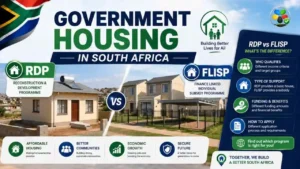
First, there is RDP Housing, which is mainly for low-income households. For those whose income is very low, the government either builds a house for them free of cost or provides it with a substantial subsidy.
Second, there is FLISP (Finance Linked Individual Subsidy Programme), which is for comparatively higher-income families. Those who earn more than the RDP income limit but cannot afford the entire housing cost on their own can benefit from FLISP.
RDP Housing in South Africa: Who Qualifies and What You Get
RDP Housing is the oldest and largest government housing programme in South Africa. Here the government builds a complete house for a qualifying household, including land, construction and basic services. Generally, the beneficiary does not have to pay the purchase price for the house – but once they receive the house, ongoing costs like municipal rates, water and electricity still remain, and these have to be paid regularly.
Who Qualifies for the RDP Benefit
Must be a South African citizen or permanent resident
The applicant must have a valid South African ID. Temporary resident permit holders or asylum seekers do not qualify for this programme.
Age Requirement
Generally, the applicant must be 21 years old or above. But if someone is married or has financial dependants, they may be considered eligible even if they are under 21 in some cases.
Household income must be below R3,500 per month
Here, the combined gross monthly income of both the applicant and their spouse or partner is considered, not just the applicant’s income. If the income is more than R3,500, there is a higher chance of falling into the FLISP category rather than RDP.
Must be a first-time government housing beneficiary
If the applicant or their spouse has previously received any government housing subsidy or government residential property, submitting a new application may become complicated.
Dependants Requirement
Generally, having dependants, such as children or other dependent family members, is a necessary requirement. Without a dependant, a single person generally does not qualify. However, there are some exceptions to this. People over the age of 60, persons with disabilities, or those with recognised dependants may be exempt from this requirement.
An important condition for receiving an RDP house is a restriction on the title deed. For the first 8 years, there is a restriction on selling the property.
First 8 Years
There is a restriction on selling the property.
After 8 Years
The restriction is lifted, and the owner can then sell the property freely on the open market.
FLISP Housing Subsidy: A Homeownership Option for Middle-Income Earners
Those who earn more than the RDP income limit but find it difficult to manage the home purchase deposit are eligible for FLISP. Remember, FLISP does not provide a free house. It is a once-off cash subsidy that is used to reduce the home purchase deposit or the home loan amount.
What Types of Properties Qualify for FLISP?
Why is FLISP Much Faster Than RDP?
In the case of FLISP, the government does not have to build a new house. The applicant chooses a qualifying property themselves and arranges a home loan, so the subsidy processing can be relatively faster.
The applicant chooses a qualifying property themselves.
The applicant arranges a home loan.
The FLISP subsidy is processed.
How to Apply for RDP or FLISP Housing
The application process for RDP and FLISP is completely different, so the two need to be understood separately.
Go to your local municipal housing office
This application can’t be done online at the national level. The entire process starts with your local municipality, city council, or district housing department. To apply, you have to go there and register your name on the government waiting list.
Register on the National Housing Needs Register
The housing office will collect all the necessary documents from you, such as your ID card, proof of income, the number of family members, and details of your current place of residence. Once the registration is completed, you will be given a registration or reference number that can be used later to check your application status.
Wait for the allocation
The municipality allocates houses based on the construction of new houses and the availability of housing units. Your position on the waiting list plays a significant role. Elderly citizens, people with disabilities, women-led households, and military veterans are generally given priority. However, the actual waiting time may vary depending on where you live and your position on the waiting list.
Get a pre-approval for a home loan
Firstly, you need to get a home loan pre-approval from a registered bank. ABSA, Standard Bank, FNB, Nedbank, Capitec, or African Bank participate in this process. The bank assesses your income and your ability to make the monthly bond repayments.
Find a qualifying property
Search for a completed residential property that you can afford.
Signed Offer to Purchase
After getting a signed Offer to Purchase, the bank or NHFC helps you with the subsidy application process. During this process, documents such as your ID, proof of income, bank statements, and the signed sale agreement need to be submitted.
Subsidy approval and payment
The FLISP subsidy is not given directly to the beneficiary as cash. It is paid to the transferring attorney as part of the property transaction, which helps reduce your deposit or loan amount.
No official fee is charged when applying for RDP or FLISP.
Realistic Government Housing Waiting Times in 2026
Waiting time for RDP is not fixed. As the national backlog is still around 2.3 million households, delivery challenges persist in the 2025–26 financial year. Budget constraints, difficulties in land acquisition, and the development capacity of municipalities are some of the main reasons why the delivery rate can be slow. So, depending on your municipality and your position on the waiting list, the actual waiting time may vary significantly.
| Province | Estimated RDP Waiting Time | FLISP Processing Time |
|---|---|---|
| Gauteng | 12–15+ years | 3–6 months |
| Western Cape | 10–15+ years | 3–6 months |
| KwaZulu-Natal | 8–12 years | 3–6 months |
| Eastern Cape | 6–10 years | 3–5 months |
| Limpopo | 5–8 years | 3–5 months |
| Mpumalanga | 4–7 years | 3–5 months |
| Free State | 4–7 years | 3–5 months |
| North West | 3–6 years | 3–5 months |
| Northern Cape | 2–5 years | 3–4 months |
Remember, the figures mentioned above are estimated timelines. The actual waiting period may vary depending on the municipality, specific housing project, budget, availability, and your position on the waiting list. There is no guarantee of any specific timeframe.
Why is there such a huge difference in the timelines of these two programmes? In the case of RDP, the government has to handle everything from land acquisition and appointing contractors to construction and infrastructure development. On the other hand, FLISP is linked to the purchase of an existing, already-built property, so the process can be relatively much faster.
Recently, there has been an increase in scams related to housing waiting lists. Some of the most common types include:
Fake housing agents who promise to help in exchange for money
False information circulated in WhatsApp groups, including fake lists of “available houses”
Fraudsters claiming to be municipal officials
Claims that waiting-list positions can be sold
SASSA Recipients and Government Housing
Many people think that if they are receiving a SASSA grant, they automatically qualify for an RDP house, but the reality is different. Receiving a SASSA grant does not guarantee RDP housing. Household income and the overall housing assessment play a crucial role in determining RDP eligibility. You have to remember that even grant income of R2,400 may be included in the household income calculation, which can then be compared with the R3,500 RDP income threshold. So, being a grant recipient can be a positive factor, but it is not the only determining factor.
Another important thing is Free Basic Services. Households that qualify may receive support for basic municipal services such as water and electricity.
Combine Indigent and Housing Registration. When you go to your municipal office to register for housing, ask to be put on the indigent register at the same time. This will unlock Free Basic Services and may also exempt you from property rates when you get your RDP house.
Common Reasons Your Housing Application
Many applicants’ applications are rejected for various reasons. These reasons can be largely avoided if you know them in advance.
You already own a property
Housing Subsidy System (HSS) data and Deeds Office records are cross-checked. If the applicant or their spouse owns any residential property in their name, the application may be rejected. After selling or transferring the existing property, there may be an opportunity to re-apply. However, this is not guaranteed and will be considered on a case-by-case basis.
If you previously received a housing subsidy
If you have previously received any kind of government housing assistance or subsidy, there may be eligibility issues when applying for a second time. This applies to both RDP housing and FLISP, as previous government subsidies may affect your eligibility.
Exceeding the income threshold
For RDP, household income above the R3,500 threshold may be a problem, while for FLISP, the income ceiling is R22,000. Income verification can be done through payslips, bank statements, UIF and SARS data.
Incomplete or incorrect documentation
No ID copy, Unsigned affidavit, Old or outdated proof of income, Incorrect banking details, Other administrative or document-related errors. Even such minor errors are a common reason for application rejection.
Your name is not on the waiting list
To receive an RDP house allocation, your name must be registered on the National Housing Needs Register. Simply living in an informal settlement does not automatically qualify you for an RDP house. Your name must be on the official housing register, and you must follow the complete municipal process.
What to Do if the Application is Rejected?
Don’t be discouraged if your application is rejected. You can still appeal.
Appeal the Decision
If your application is refused, the applicant can appeal the decision to the provincial Department of Human Settlements.
Appeal Within 30 Days
Normally you have 30 days from the date you receive the notice of rejection to appeal.
Formal Review Process
The issue can also be raised again through the provincial housing tribunal or a formal review process, if required.
Your Local Housing Office
The first point of contact for registering and checking your status.
Provincial Department of Human Settlements
For appeals and escalations.