
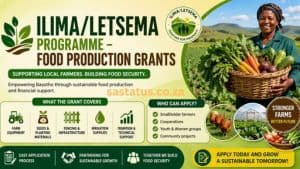
Ilima/Letsema Programme
2026/27
Financial Assistance for Farmers — DALRRD
What is Ilima/Letsema?
In South Africa, farming is still a huge part of everyday life for most families, especially in rural areas where it’s really about survival, earning money, and putting food on the table. There have been various initiatives by the South African government aimed at helping struggling farmers cope with food production and income generation challenges. Ilima/Letsema Programme is one of them.
This programme is all about helping vulnerable farming communities grow more food. It supports farmers who actually have land but don’t have the tools, gear, infrastructure, or cash they need to farm properly. Instead of quick fixes, Ilima hopes to build a long term self-sustaining system that will continue to provide support to communities long into the future.
The names themselves carry much cultural significance.
Even before there was a structured government program, many African communities engaged in such a communal working effort during planting and harvest time.
The Four Main Agricultural Focus Areas
Grain Production
Crop cultivation is one of the primary concerns. Corn, wheat, and sorghum are common foods in the diet of many South Africans. Assistance could be offered to farmers in terms of farm machinery, fertilizer, herbicides, and seeds to increase crop yields.
Livestock
Livestock help can be another important aspect of the programme. These include help regarding animals like cattle, goats, sheep, poultry, animal fodder, breeding, or even veterinary services. Healthy livestock often means greater financial stability for families who rely on agriculture.
Horticulture
Horticulture produces fruits and vegetables from gardens at homes, schools, and communities using seedlings, irrigation, shade nets, and tools.
Aquaculture
Fish culture is another alternative for both food and cash earning particularly for the regions where inland aquaculture activities can be undertaken. It further opens up one more choice for the people in the community other than engaging only in agriculture.
What does Beneficiaries Receive
Seeds and Seedlings
The most common help for starting crops.
Fertilisers
Used to improve soil and help plants grow better.
Garden Tools
Basic equipment and implements for farming work.
Animal Feed
Food for poultry and livestock.
Animal Medication
Veterinary medicines to keep animals healthy.
Irrigation Systems
Water supply setups for crops.
Mechanisation
Tractor services for ploughing land.
Pesticides and Herbicides
Chemicals that protect crops from pests and weeds.
Gardens and Production Programmes
ILEMA/Letsema supports food production at multiple levels, from persons’ households to community level projects.
🏠 Household Gardens
Families in vulnerable situations receive kits to start backyard gardens, complete with seeds, plants, fertilizer, and basic tools. The goal is to help them grow their own vegetables and rely less on buying food.
🌍 Community Gardens
There are communal garden plots within the village or township. Assistance is provided through fencing, irrigation, tools, and other materials. Everyone works together to grow food for the whole community.
🏫 School Gardens
Schools set up gardens to support their feeding schemes. The learners are also taught about gardening so that they can understand where their food comes from.
🏥 Public Gardens
These food gardens are set up at clinics, churches, and community centres. They focus on areas where people struggle most to get food.
💧 Irrigation Scheme Revitalization
The old irrigation system is modified and extended to serve the large farm again; this puts into cultivation many thousands of hectares. The activities include road reconstruction, canal repair, fence construction, and the introduction of improved equipment.
National Targets
Ilima/Letsema works under the National Development Plan (NDP) Vision 2030.
Application Procedures for Ilima/Letsema
Applications for Ilima/Letsema are processed through your district agricultural office at provincial level.
Visit Your Office
Go to your nearest district agricultural office. Speak to an extension officer or coordinator. Request and fill the application form manually.
Fill the Form
Give all necessary information regarding your education and farming experience. Describe your farm project and need for support.
Attach relevant documents regarding personal identification, land ownership, and your business plan.
Application Submission
There is no fixed time for applying. Deadlines for submission differ from province to province. It is advisable to visit local newspapers or the department website for deadlines.
Assessment
Your Province will be assessing your applications, and the inputs and infrastructures will be provided to the successful ones during the following year.
👨🌾 70,000 farmers are supported every year under the program.Special points
👥 People of Priority
Women, youth, disabled and poor rural families are more likely to get the aid. The reason behind targeting women, youth, disabled and poor rural families is to alleviate poverty and reduce inequalities by increasing production of food.
📍 Eastern Cape Province
Ilmina Lokulima, which is otherwise referred to as The Eastern Cape Plan 2025-2030, will be introduced in the Eastern Cape province in 2025-2030.
📦 In 2024/25, 30,000 households received production packs through this programme.📄 Submission of Applications Manually
Applications should only be submitted to the closest district agricultural office.
Related Post
- SEDFA Support Programmes (SEDA)
- Presidential Youth Employment Intervention (PYEI)
- NYDA Grant Programme
- Funza Lushaka Bursary
- Global Agriculture and Food Security Program
- REIPPPP Renewable Energy IPP
- Section 12B / 12BA Tax Allowances
- EEDSM Programme
- Blended Finance Scheme
- Agro Energy Fund (AEF)
- South African Medical Research Council (SAMRC)
- Comprehensive Agricultural Support Programme (CASP)
- National Research Foundation (NRF)
- National Student Financial Aid Scheme (NSFAS)