
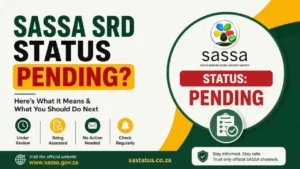
for Months?
Common Reasons and How to Fix It — 2026 Guide
Many people get worried when they see a “Pending” status after applying for the SASSA SRD R370 grant. But first, it is important to understand that a Pending status does not mean that your application has been rejected. Pending simply means that your application is still going through the verification and processing process.
Your application details are being checked against information from SARS, UIF, your bank details, and other government databases. Below, we will discuss in detail what you should do and what the possible reasons behind the Pending status are.
What Does “Pending” Really Mean for Your SASSA SRD Application?
SASSA’s SRD applications are processed through a system called SOCPEN. This system takes each application through several automated verification steps. During this verification process, the information you provided in your application is cross-checked with SARS (South African Revenue Service), the Department of Home Affairs, UIF (Unemployment Insurance Fund), NSFAS, and several other government databases. In simple words, Pending means that your application has reached SASSA, but one or more verification steps have not yet been completed.
Sometimes, there may be a delay in receiving a response from an external database, a flag may be raised, or your application may be waiting in the system queue. The important thing is that Pending itself is not a negative sign; it does not directly mean that there is any problem with your application.
Each Possible SASSA Status and its Meaning are Given Below
| Status | Meaning | Action Required |
|---|---|---|
| Pending | Application is still under verification/processing. | Wait, check the status regularly. |
| Approved | Application approved. | Wait for the payment date. |
| Paid | The money has been sent. | Check your bank account or payment method. |
| Declined | Application rejected. | See Reason, check if there is a chance of appeal. |
| Cancelled | Your application has been withdrawn or marked as suspected fraud. | Report to your local SASSA office with your original ID. |
| Referred | Sent for additional review. | Wait until the manual review is complete. |
| Status Changes Monthly | Eligibility is assessed every month. | Check your status every month. |
Status Changes Monthly
The status of the SRD grant is assessed again every month. This means that even if your application showed an Approved or Paid status in the previous month, the status may change in the current month because a new verification process is carried out. Therefore, it is important to understand the Pending status of the current month and the result of the previous month separately.
Receiving the grant payment in the previous month does not guarantee that you will receive it again this month. It is always better to check your status separately for each month.
5 Reasons Your Status Is Stuck on Pending
SARS income data mismatch
One of the most common reasons for a Pending status is a mismatch in income information. SASSA compares your declared income with SARS records, earnings reported by employers, and UIF contributions. Sometimes, income information from a previous part-time job or a one-time payment can trigger a flag during the verification process, even if you are not currently receiving that income. If there is this type of mismatch, your application may be sent for additional review. This process may take around 30 to 60 days due to the SARS data verification, as it depends on a database outside SASSA’s own system.
Bank account verification failure
The bank account must be in the applicant’s own name and must be active. Verification may fail because of an incorrect account number, a closed or dormant account, or a mismatch between the name on the ID and the name of the bank account holder. Many people use a family member’s or friend’s bank account for convenience, but this should not be done, as it can cause the verification process to be delayed or get stuck. Until the bank details verification is completed, the application may remain in Pending status.
Duplicate application detected
If there are multiple active applications linked to the same ID number, the system flags them as duplicates. This often happens when someone thinks their first application has been lost and submits another application, or when they apply multiple times through different channels, such as the website and WhatsApp. These types of applications are sent for manual review, which can further delay the processing.
ID document flagged for manual review
Your identity and citizenship information is cross-checked with the records of the Department of Home Affairs. If there is an error in the ID number, if the ID was recently issued or replaced, or if there is any mismatch in the ID information, the application may be sent for manual review. Manual review naturally takes longer than an automated check.
System processing backlog
Sometimes, there is a sudden surge in the number of applications, which can create a backlog in processing. This backlog is particularly common in January and April, while a smaller increase in applications may also be seen in October. During these periods, even applications with no actual problems may remain in Pending status for a long time. Due to backlogs during peak periods, the delay may extend to 60 to 90 days. However, this is not a fixed or guaranteed timeframe, and the actual processing time may vary depending on the situation.
How Long Should You Wait for a Status Update?
Processing Timeline
For normal and straightforward applications, the usual processing time is generally 5 to 10 business days. If you apply during the first week of the month and all the information you provide is correct, your status may change within about two weeks in the best-case scenario.
However, if a verification flag is raised, the processing time may extend to 30 to 60 days. In particular, delays caused by a mismatch in SARS data may be largely beyond SASSA’s control because the process depends on a response from another government agency.
During peak periods, processing may take up to 90 days or even longer due to backlogs.
Do Not Reapply While Your Status Is Pending
Important Reminder
This is a very important point. As long as your application is showing a Pending status, you should not submit another application.
If you submit a new application, the system may mark both applications as duplicates and send them for manual review. As a result, instead of reducing your waiting time, it may actually make the process take even longer.
Unless your current application officially shows a Declined or Cancelled status, you should not reapply simply because it is showing Pending.
During this period, you should regularly check your status, but avoid submitting unnecessary new applications repeatedly.
Follow These Steps to Resolve Your Pending Status
Step 1: Check your current status
First, check your current status and see exactly what it shows. Check your status through the official SRD portal and note down the exact wording of the status and the last update date. This information will be useful during escalation later.
Open Official SRD PortalStep 2: Check whether your banking details match your ID
Make sure your bank account number, account type, and branch code are correct. Most importantly, check whether the name of the bank account holder matches the name on your ID. Remember, even small differences in spelling, initials, or surname may cause problems during verification. To update your banking details, use the official SRD portal.
Update Banking DetailsStep 3: Check if there is any conflict in your UIF and SARS status
If you have recently worked somewhere, your employer may have reported that income to SARS. UIF registration or income records may also cause problems during means-test verification. Check your SARS (www.sarsefiling.co.za) and UIF (www.ufiling.co.za) records carefully. If there is any incorrect or outdated income record, you need to get it corrected through the relevant authority.
Open SARS eFiling Open uFilingStep 4: If 90 days have passed, go to a SASSA office for a manual check
If your application status shows “Pending” for more than 90 days and you are sure that your bank and income details are correct, then visit your nearest SASSA office.
Things to bring:
- Your original South African ID
- The cellphone with the number you used on your application
Tell the SASSA staff that you would like a “manual review of your SRD application.” They will check the system and let you know exactly where your application is stuck.
Find Nearest SASSA Office5 Common Mistakes That May Delay or Reset Your Application
Reapplying while Pending
Many applicants think their application has been lost or is stuck somewhere, so they submit a new application. But this can create a duplicate flag and extend the processing time even further.
Changing Banking Details Mid-Review
If you change your bank details while your application is being processed, the entire bank verification process may have to start again from the beginning. This may add another 10–15 business days to the processing time. So, you should update your bank details only if they are genuinely incorrect or need to be changed. Do not change your account just for convenience or for any other reason.
Using a Different Phone Number
A specific cellphone number is linked to your application for verification and communication. If you use a different phone number or SIM card, it may cause issues with identity verification. As much as possible, use the same phone number that you used in your original application. If that number is lost or becomes inactive, you should update it through an official SASSA office rather than simply starting to use a different number.
Warning: Reapplying Resets Your Queue Position
It is important to remember that whenever you submit a duplicate application, the system sends both applications for review again without considering the progress of your previous application. As a result, the delay you hoped to reduce by submitting a new application may actually become even longer.
🔍 Check Your SRD StatusWhen Should You Escalate Your Application?
Escalating a Pending Application
After a reasonable amount of time has passed, if your application status still shows as Pending, you should consider escalating the matter. Especially if it has remained pending for more than 90 days, you should actively follow up.
As a first step, you can contact SASSA’s toll-free line at 0800 60 10 11. The line is open from Monday to Friday, from 08:00 to 16:00. Before calling, keep your ID number and application reference number ready. Ask the agent to check your application in the SOCPEN system and find out which verification step is causing the delay.
If you are unable to contact SASSA through the toll-free line, you can visit your nearest SASSA regional office directly. For this situation, it is required that you come up with your original ID, proof of address, and the cellphone number used in applying. There is an option through which one may ask for manual intervention or correction of information through the office.
It is also worth noting that there are alternative channels of external escalation, such as the Black Sash (Human Right Organisation acts for social grant related issues) and the Ombudsman Protector complaint channel.