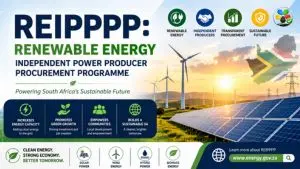
South Africa · IPP Procurement Programme
REIPPPP 2026
Renewable Energy IPP
Renewable Energy Independent Power Producer Procurement Programme
2026
Applications Open
IPP
Power Producers
MW+
Capacity Procured
DFFE
Administered By
Renewable Energy | DPME / DoE 2026
REIPPPP is a major initiative launched by the South African government in 2011. Under the initiative, the government invites private companies that generate electricity using solar, wind or biomass. The company with the best offer signs long-term Power Purchase Agreements (PPAs) with Eskom. Eskom buys electricity from them and supplies it to the national grid.
1
Government
Invites private renewable energy companies.
2
Private Companies
Submit competitive bids using solar, wind or biomass.
3
PPA Signed
Successful bidders sign long-term Power Purchase Agreements with Eskom.
4
National Grid
Eskom purchases electricity and supplies it to the national grid.
7,300 MW+
Electricity Generated
IPP Office
Managed by DMRE, National Treasury & DBSA
Quick Summary
Power Added to Grid
7,336 MW
Achieved through 95 independent power projects now operational.
Funds From Private Sectors
R256 Billion
Investment pledged by private firms from 2011 onwards.
Carbon Reduction
22.5 Million Tonnes
Estimated CO₂ emissions prevented.
Water Usage Reduction
26.6 Million kL
Amount of water saved compared to conventional plants.
Bid History Since 2011
The government has released renewable energy projects in 7 phases since 2011 about 15,864 MW has been awarded in total, but only around 7,336 MW is currently connected to the Grid.
| Bid Window | Year | Capacity Awarded | Projects | Status / Notes |
|---|
| BW 1 | 2011 | 1,416 MW | 28 | Operational
First Round. All projects operational. |
| BW 2 | 2012 | 1,044 MW | 19 | Second Round. |
| BW 3 | 2013 | 1,456 MW | 17 | 3rd Round. Larger projects included. |
| BW 3.5 | 2014 | 200 MW | CSP Only | Special round for Concentrated Solar Power. |
| BW 4 | 2015 | 2,205 MW | 26 | Capacity increased significantly. |
| BW 5 | 2021 | 2,583 MW | Preferred Bidders Selected | Restarted after a 6-year gap. PPA signed, construction ongoing. |
| BW 6 | 2022 | 5,200 MW | 6 Solar PV Projects | Largest round so far. Solar only. |
| BW 7 | 2023/24 | 1,760 MW | 8 Solar PV Projects | Latest round. Preferred bidders announced. |
REIPPPP Bid Window 7: Results and key Commitments
Launch
BW7 was announced in December 2023.
Original Target
The government wanted 5,000 MW total. That was 1,800 MW from solar and 3,200 MW from onshore wind.
High Level of Interest
DMRE received 48 bids amounting to 10,200 MW in total. Thus, interest was well above target.
48 Bids • 10,200 MW
Screening Outcome
After screening, only 30 solar and 4 wind power projects passed the criteria set.
Preferred Bidders
Only 8 solar projects have been identified as preferred bidders. None of the wind projects qualified this time. Total capacity 1,760 MW.
8 Projects • 1,760 MW
Future Selection
DMRE stated that more projects may be selected in future once there is availability of grid space.
Ownership Requirement
The winning projects have agreed that 49% of each project should be held by South African citizens.
49% South African Ownership
BEE Requirement
Each project has to be 46% black in average terms in terms of business participation and ownership.
46% Black Ownership
Employment Generation
It is expected that these projects will generate 6,971 job opportunities during the construction period.
6,971 Jobs
Local Procurement
R7.8 billion worth of goods and services need to be procured locally during the construction period.
R7.8 Billion
Support for Black Businesses
The project also committed to spending R3 billion with black-owned companies.
R3 Billion Commitment
Renewable Technologies That Qualify
Technology
Solar PV
Ground-mounted photovoltaic systems. Most widely adopted option due to lower setup costs.
Technology
Onshore Wind
Land-based wind turbines.
Technology
Concentrated Solar (CSP)
Thermal solar with storage. Delivers power even after sunset using stored heat.
Technology
Small Hydro
Hydropower up to 40 MW. Ideal for regions with consistent river or stream flow.
Technology
Biomass & Biogas
Energy from organic/landfill waste. Turns waste management into a power source.
Technology
Battery Storage
Handled separately via BESIPPPP. Ensures grid stability by storing excess renewable output.
How the REIPPPP Programme Works
The REIPPPP follows a specific competitive tender process for each Bid Window.
DMRE Releases the RFP
DMRE publishes the tender notice. The government announces the type of project it requires – solar or wind – the required power capacity (MW) and where the plants can be built. This notice also mentions the evaluation criteria that is typically 70% for the lowest price and 30% for socio-economic development. The submission deadline is also announced. A fee of R25,000 must be paid for each project. The fee is non-refundable and will not be returned when the bid is submitted.
Tender OpensIPPs Submit Their Bids
The companies submit their entire proposal. The proposal includes the project design, financial details, the price per unit of electricity, the percentage of local ownership, the amount of goods to be procured locally, the number of jobs to be created, and plans for local community development. Bank approval is mandatory. The bank must confirm in advance that it will finance the project.
Proposal SubmissionAssessment and Selection
An independent committee evaluates the submitted bids. All bids are reviewed through a secure evaluation process. The bids are scored based on two criteria: 70% on price and 30% on socio-economic development. The bid offering the lowest price and the greatest socio-economic benefits is selected. The names of the selected companies are announced. The results are usually announced within 3 to 4 months.
Bid EvaluationContract Signing and Financial Closure
The selected companies sign a 20-year agreement with Eskom. Under this agreement, Eskom purchases electricity from them at a fixed price for the next 20 years. Financial close is completed once bank financing and all required approvals are in place. This step usually takes 6 to 12 months. Delays are usually caused by grid connection, regulatory approvals, and financing arrangements.
20-Year PPAConstruction and Grid Connection
The project must be completed and connected to the grid within 24 months of signing the agreement. Eskom connects the project to the national grid. Once the project becomes operational, it sells electricity to Eskom for the next 20 years.
Commercial OperationLimited grid capacity remains the primary constraint
Insufficient Grid Capacity is the Main Constraint
REIPPPP is running 2 to 3 years behind schedule. There are no proper transmission lines in areas where solar and wind resources are the best, like the Northern and Western Cape.
Bid Window 6
No wind projects were selected because the available grid infrastructure could not support additional connections.
Bid Window 7
Although bids totalled around 10,200 MW, only 1,760 MW of grid capacity was available.
Current Situation
Most of the available transmission capacity has already been allocated to existing private renewable energy projects.
Impact
Limited transmission capacity continues to delay new renewable energy projects despite strong private-sector interest.
BESIPPPP: Battery Storage Project to Support the Grid
The government has another project like REIPPPP called BESIPPPP (Battery Energy Storage Independent Power Producer Procurement Programme). This project was announced alongside REIPPPP Bid Window 7. The aim of this project is to set up 615 MW of battery storage capacity across 8 Eskom substations in North West, Gauteng, and Free State.
Battery Storage Capacity
615 MW across 8 Eskom substations
Project Locations
North West, Gauteng and Free State
Purpose
These batteries will help stabilize grid voltage, supply electricity during peak demand, and create more space in the grid to connect new renewable energy projects.
Bid Results
31 companies bid for the 8 sites, and 8 companies were selected — one for each site.
Who Can Apply for Participation in REIPPPP
REIPPPP focuses on attracting developers, investors and energy companies – not individual consumers or small companies. Typically, applicants will require:
1
Significant finance (millions of rands)
2
Technical, legal and financial experience
3
BEE partners and community involvement
4
Environmental and grid approvals
Section 12B: Tax Incentives for Renewable Energy Investments
Businesses investing in renewable energy can claim accelerated tax depreciation under Section 12B of the Income Tax Act. Solar PV up to 1 MW gets 100% deduction in year one, while larger systems get a 50/30/20 write-off over three years.
Solar PV ≤ 1 MW
100%
Tax deduction in the first year.
Solar PV > 1 MW
50 / 30 / 20
Tax deduction spread across three years.
Related Post
Frequently Asked Questions (FAQs)
1What exactly is REIPPPP?
It’s a government-backed bidding process where private firms compete to build renewable power plants — solar, wind, and similar sources — and then supply that electricity to the national grid through long-term agreements. In just one decade, it has attracted billions of private dollars and increased the country’s electricity capacity by several thousand megawatts.
2Which body oversees the programme?
The responsibility falls on the IPP Office, which is an integrated office involving the energy ministry, the treasury department, and a state development finance institute.
3Can a regular business or homeowner submit a bid?
Indirectly though, as the bidding system involves only well-endowed developers and energy companies. Others participate indirectly through providing material, service or labor support to the winning project.
4On what basis are winners picked?
Two criteria will determine whether it succeeds: its competitive pricing of power and its social value – through job creation, empowerment equity holdings, and community uplifting. After selection, the developer signs up to a twenty-year supply deal with the utility company.
5What’s holding the programme back?
The only problem facing such an initiative is the fact that the national grid is not yet able to absorb all of the proposed renewable energy production capacity. This has led to promising bids being turned down purely because there’s no room left on the transmission network.
Useful Links & Resources
IPP Office Website
Official programme hub
DMRE REIPPPP Page
Bid windows, notices and procurement updates
BW7 Preferred Bidders Announcement
Minister Ramokgopa statement
REIPPPP Overview
Comprehensive programme history
Academic Review & Lessons
Journal of Energy in Southern Africa
NDC Partnership Case Study
International best practice analysis