
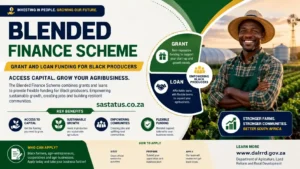
Scheme 2026
Grant and Loan Funding for Black Producers
If you want to grow in the agricultural sector in South Africa, the biggest obstacle is a lack of money, especially for those who were historically disadvantaged. To address this issue, the government has introduced the Blended Finance Scheme. This scheme is simple yet powerful.
The government grant will be considered as the farmer’s own capital. As a result, the bank faces much lower risk in providing the loan. This benefits both the farmers and the banks.
Its main aim is not only to provide funding but also to bring Black farmers into commercial farming. So that they can transform from small-scale farmers into successful commercial farmers.
Blended Finance is more than just a loan or a grant. It serves as a bridge that helps bring Black Farmers into the mainstream of agriculture.
Quick Overview
Grant-to-Loan Financing Ratio
DALRRD Blended Finance · 2026 Intake
Find Your Funding Mix
Your farm’s scale decides how funding splits between a grant you never repay and a loan at market rates. Pick your category to see the breakdown.
As a smallholder, up to 60% of your funding arrives as a grant you never repay — the scheme is built to make entry easiest for the smallest producers.
Blended Finance System Partners
To date, an MOA (Memorandum of Agreement) has been signed with three financial institutions.
Land Bank
- Land Bank’s role: Fund Administrator and Lender
- MOA Signing Date: October 2022
- It performs two key roles. First, it manages grant funds for all participating institutions. Second, it also provides loans to farmers.
- Update: As of July 2024, Land Bank has approved 205 applications.
Industrial Development Corporation (IDC)
- Role: Development Finance Partner
- MOA Signing Date: March 2021
- It was the first institution to join the programme, making it a pioneer.
- It has approved R2.1 billion for emerging Black farmers. It not only provides financial support but also assists farmers from farm establishment to business operations.
ABSA
- Role: Commercial Bank Partner
- MOA Signing Date: May 2024
- It is the first major commercial bank to join the scheme.
- It provides loans in accordance with DALRRD guidelines.
- However, the bank may apply additional lending requirements based on its own risk assessment.
FNB and Nedbank. No MOA has been signed yet. Therefore they have not officially joined the scheme.
To Get a BFS Grant, You Must “Pass” Economic Benefits Scorecard
Simply applying for the Blended Finance Scheme is not enough to receive a grant. To qualify for the grant, you must score at least 20 out of 50 on the Economic Benefits Scorecard. It is not an exam; rather, it is a screening process to evaluate whether your farm can contribute to national development.
Why This Scorecard?
The government’s objective is not only to develop farmers, but also to bring Black farmers into the commercial farming sector, create new employment opportunities, increase food production, and promote environment-friendly agriculture.
If your application is driven solely by personal profit,you may not qualify for approval under the scheme.
For that reason, you will be assessed using seven criteria.
How is The Scoring Done?
The total score is 50. If you score at least 20 out of 50, you will be eligible for the grant. If you score below 20, your application will not be processed further.
20 / 50 or Above
You will be eligible for the grant.
Below 20 / 50
Your application will not be processed further.
Eligible Agricultural Commodities (AAMP)
7 Criteria of Scoring
Black ownership and farm transformation
At least 60% of the farm’s ownership must be held by Black farmers. Not only on paper, the farm must also be genuinely managed by the Black owner.
People-centered growth and profit sharing
Farm workers must be given at least 10% of the profits. If your farm contributes to local development, you will have an extra advantage.
Personal Investment Contribution
Besides the government grant, you will also have to contribute to your project .You can demonstrate your contribution in several ways such as providing money, land,machinery or your own labour.
Job Creation & Employment Impact
You have to give a rough estimate of how many permanent or seasonal jobs your farm will create. The more jobs it generates, the higher the score.
Food security and Agricultural Output
It will be assessed whether your crops are contributing to local or national food supply. The higher the production, the higher the score.
Sustainable farming and environmental care
whether you are conserving water and soil through your farming practices will be evaluated. Lower use of chemical fertilizers and climate-resilient farming practices will enhance your score.
Local Value Addition and Market Access
it will be evaluated whether you are adding value to your raw products by processing them locally instead of selling them as raw materials. Having an export plan will earn you a higher score.
Grant/Loan Mix in BFS
The grant-to-loan ratio under the Blended Finance Scheme (BFS) is determined by the size of the farm. As farm size increases, the grant portion decreases while the loan portion increases.
1. Smallholder Farms
2. Medium-Scale Farms
3. Large-Scale Commercial Farms
Commodities Eligible for Support under AAMP
This program would benefit those involved in the following farming areas provided by Agriculture and Agro-Processing Master Plan.
growing of fruits and nuts
growing of vegetables
growing of maize, wheat and other grains
sugarcane farming
poultry farming of chickens and birds
livestock farming
pig farming
growing of industrial crops
farming of fish and sea products
forestry production
Who’s Not Eligible to Apply
Before applying, it’s worth checking whether you fall into any of these excluded groups:
Politicians currently in office must wait 12 months after leaving before applying
Foreign nationals, people with dual citizenship, and illegal immigrants are not eligible
The grant is not available to government and state-owned companies employees for 24 months
Applicants who are already struggling financially and need the grant for settling debts will not be considered.
Part-time farmers even with a farm manager are excluded
Business ventures that do not give the farm workers any say in the management of the firm are excluded
Joint ventures also require black producers to be at least 60% owners, otherwise they don’t qualify
Politically exposed persons who could pose a reputational risk are prohibited
Staff working for the organisations that administer these funds (BFS) cannot apply
Individuals who have misused governmental assistance in the past
ventures with no plans to share profits with farm workers
Special advisers in agricultural programmes at any level are excluded also.
BFS Funds Can Be Used For
Buying Farmland and Farm Businesses
BFS finding can be used to buy agricultural land or already operating profitable agricultural companies.
Farm Expansion and New Projects
This fund can be used to increase the production of existing farms or to establish a completely new farm. Projects can be developed on unused land or at new locations.
Machinery and Farm Setup Costs
Tractors, pumps, pack houses, godowns, irrigation systems, fencing—all these capital investment costs can be covered through BFS funding.
Daily Operating and Input Costs
Daily farm operating expenses, fertilizers, seeds, diesel, labour wages, and the working capital required for seasonal production can be financed through BFS funding.
Crop and Livestock Insurance
A part of crop and livestock insurance costs can be covered by the BFS grant.
Points to Remember
Long-Term Lease Agreements
The bank now accepts long-term lease agreements as security documents instead of land ownership. If the lease term exceeds the loan term, you can apply for BFS funding without a title deed. This is a major benefit for farmers under the land reform programme.
Agro Energy Fund
DALRRD and Land Bank have jointly launched an Agro Energy Fund with a budget of R1.21 billion. It consists of R500 million in grants and R710 million in loans. The fund provides financial support for solar energy, other alternative power systems, irrigation, and cold storage on farms. Farmers of all sizes in South Africa can apply for this fund. Applications must be submitted through the Land Bank.
Related Post
- SEDFA Support Programmes (SEDA)
- Presidential Youth Employment Intervention (PYEI)
- NYDA Grant Programme
- Funza Lushaka Bursary
- Global Agriculture and Food Security Program
- REIPPPP Renewable Energy IPP
- Section 12B / 12BA Tax Allowances
- EEDSM Programme
- Agro Energy Fund (AEF)
- South African Medical Research Council (SAMRC)
- Comprehensive Agricultural Support Programme (CASP)
- Ilima/Letsema Programme
- National Research Foundation (NRF)
- National Student Financial Aid Scheme (NSFAS)