
SHARE
WhatsApp Telegram

Table of Contents

South Africa  ·  Health Research Institution
South African Medical
Research Council

SAMRC — Building a Healthier, Stronger Nation

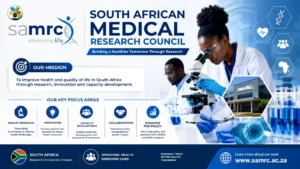
The South African Medical Research Council (SAMRC) is one of the country’s leading health research institutions, recognised as South Africa’s largest local funder of health research. Its main goal is to help build a healthier, stronger nation through research, innovation, and evidence-based policy. SAMRC drives health research through its internal research units, university-based research centres, competitive funding, and partnerships. Its Research Capacity Development (RCD) Division and Grants, Innovation and Product Development (GIPD) Unit support researchers at every career stage — from postgraduate students and PhD candidates to early-career, mid-career, and established researchers. SAMRC’s funding strategy focuses on supporting Black and women scientists and strengthening Historically Disadvantaged Institutions (HDIs).

RCD Capacity Division
GIPD Grants & Innovation
HDIs Institutions Supported
#1 Local Health Funder
Research Funding  |  All Career Stages

Two Main Funding Systems

1. Research Grants
Research Funding
SAMRC gives research grants to health researchers working at recognised institutions. Its main programme, the Self-Initiated Research (SIR) programme, supports new independent health research with up to R200,000 a year for three years. Other grants help young researchers, doctors and other health professionals who start research after a PhD, and experienced scientists working to become independent researchers.

The GIPD unit also manages international research grants for new health technologies and ideas. It works with organisations such as EP PerMed (personalised medicine) and the Dutch Research Council, along with other international partners.
2. Scholarships and Trainings
Scholarships & Training
SAMRC funds Masters/PhD scholarships and clinician training through programmes like the Postgraduate Research Associate Programme, Internship Scholarship Programme, BM-NHSP, and Clinician-Researcher Development Programme.

These prioritize Black, Coloured, Indian, and HDI candidates in fields like biostatistics, genomics, epidemiology, and digital health, with supervision required from SAMRC-affiliated researchers.

Key Health Research Area

🦠 Infectious Diseases
Firstly, infectious diseases like HIV/AIDS, tuberculosis, and their associated epidemics continue to be a serious problem.
❤️ Non-Communicable Diseases
Secondly, non-communicable diseases like diabetes, heart diseases, and cancer are increasing.
👩‍🍼 Maternal and Child Health
Thirdly, the health of mothers and children should be improved through proper nutrition and healthcare provision.
🏥 Resilient Health Systems
Finally, research also targets violence prevention, injury management, vaccine development, digital health innovations with AI, epidemiological studies and new drug discovery to build a resilient health system.

SAMRC’s Key Research Grants

✓ Self-Initiated Research (SIR) Grant

💰
Funding: Up to R200,000 a year, for three years.
👨‍🔬
Who it’s for: Researchers based at a recognised institution who want to lead their own original health research.
📂
Two categories:
  • Early-career researchers (this is the main target group).
  • Mid-career and senior researchers — but they need to show how the grant will help build research capacity in others.
🏆
One grant per person: You can only receive an SIR grant once in your career.
Who gets preference: First-time applicants, Black and women scientists, and researchers from institutions with limited resources.
🚫
Who can’t apply: Staff working in SAMRC’s own intramural research units aren’t eligible.

✓ SAMRC Early Investigators Programme

💰
Funding: R200,000 a year for research costs, plus R300,000 a year toward the researcher’s salary.
🚀
Who it’s for: Early-career scientists who show strong potential to become future research leaders.
🎓
Eligibility: A research doctorate with 3 to 5 years of postdoctoral experience — clinician-scientists only need 1+ year.
🏛️
Institution’s role: The host institution has to commit to appointing the applicant as a researcher, cover day-to-day running costs, and provide the infrastructure needed for the work.
📌
One grant at a time: Can’t be combined with any other SAMRC capacity development grant.

✓ Clinician Post-PhD Career Development Programme

👨‍⚕️
This one’s built for clinicians who’ve crossed the PhD finish line in the last five years and now want to step confidently into independent research.
🎯
Who it’s for: Clinicians who completed their PhD within the past 5 years.
🚀
Goal: Build the skills and confidence to become an independent investigator.
🏛️
Institution must provide
  • Research infrastructure.
  • Equipment and running expenses.
  • Mentorship and research leadership support.
📅
Funding period: 2 years, renewable for a third year based on performance.
Transformation focus: Priority given to black and female clinicians with strong potential in research.

✓ Researcher Development Programme

🎓
The programme targets the researcher just prior to completing his/her degree; the target audience being PhD candidates in the last 12 months towards completion of the degree and who are affiliated with a university or a SAMRC unit.
👨‍🎓
Target Audience: PhD Candidates in last 12 months towards PhD.
🎯
Programme Objective: To smooth the transition from ‘PhD Candidate’ to ‘independent researcher’.

Eligibility Criteria

📝
A signed agreement from the research supervisor. To apply during the formal application procedure.
📌
Grant Category: Grant rather than a fellowship (one-time award)

✓ SAMRC Intramural Postdoctoral Programme

🔬
It targets postdocs securing a position within the SAMRC intramural research units.
👨‍🎓
Target Audience: SAMRC intramural research units researchers within 5 years of PhD.
📅
Duration of Funding: Up to 5 years (initial 3 years with 2-year possible extension).
🏛️
Hosting Unit must provide
  • Research training
  • Facilities and overhead costs
  • Mentorship
  • Professional development
Condition for renewal: Based on satisfactory annual progress report.

✓ Scholarship Programmes

🎓
Scholarship programmes:- The RCD division gives huge scholarships for students who are in their masters or PhD.But there is a condition- your supervisor should be a SAMRC researcher.

Bongani Mayosi National Health Scholars Programme (BM-NHSP)

🎓
This is for those who are aiming for PhD in health and clinical research. It gives an opportunity to the young scientist paving their way for research in Universities. It helps strengthen their research profile that gives them a higher probability of a permanent job later. This programme is aligned with the NDoH human resource strategy and national health priorities.

Clinician Researcher Development Programme

👨‍⚕️
It is designed for the doctors who are pursuing PhD studies at South Africa’s medical schools. Its main aim is to make highly efficient clinical scientists beside doctors, so that they can pursue careers in academic medicine.One needs a supervisor to get this scholarship from SAMRC.

Postgraduate Research Associate Programme

📚
Its is a fully funded scholarship for those who want to do masters and PhDs in — biostatics, genomics, epidemiology, data science, digital health— where people are already low. This programme prioritizes designated groups and HDI candidates. The supervisor must be a SAMRC researcher. 2-year scholarships are available for scarce skills fields.

Vaccinology Programme

💉
This programme is focused on vaccine research. It covers Vaccine development, Manufacturing,Clinical trials,Immunology. Supports early-career researchers.

How to Apply

1
Registration
Register for the RIMS Database. Scholarships should be applied for via the online application available on the funding page.
2
Read the Call Documents
  • Criteria for eligibility
  • Documents required
  • Guidelines for budget
  • Application procedure
3
Upload Documents
Complete the online application form Upload the following documents:
  • Research proposal/abstract
  • Institutional letter of support Budget
  • resume
  • The candidate must complete a commitment form for scholarships.
4
Submission Deadline
Applications generally close in August. No late applications will be accepted.
5
Results and Discussion
The applications are reviewed by experts. Successful candidates only will be contacted. Results will generally be released by December 31.

📌 Important Note

Only successful applicants will be contacted. The SAMRC will not notify applicants who did not succeed. If you do not receive a response by December 31, your application was not successful.
🌍 International Partnerships
🤝
Currently, SAMRC is on a joint venture with EP PerMed CARMEN 2026 that Supports international research on personalised medicine.

Core Focus Areas

❤️ Cardiac diseases
🩺 Metabolic Disorders
🧬 Renal diseases
💡 EP PerMed Call for Research, Innovation and Technology

Related Post

Frequently Asked Questions (FAQs)

Q

What is SAMRC and what does it really do?

SAMRC is an acronym for South African Medical Research Council, which happens to be the number one government organization in the country that finances health and medical research projects in South Africa. Apart from direct funding it also collaborates with other organizations to ensure South African researchers access funding for their projects in order to make the country healthier through research and innovations.
Q

What amount of money can I get from SAMRC?

It greatly depends on which grant you are applying for. The SIR grants are capped at R200,000 annually for three years while career development grants like Early Investigators Programme grants are much bigger, providing up to R200,000 for research purposes and R300,000 to cover part of the salary of the researcher. Scholarships for PhD and Master’s are about R250,000 annually.
Q

Do I have to be a South African citizen in order to apply?

Yes, in most cases. South African citizenship or at least permanent residency is required in case of SIR grants, scholarships and career development grants. Foreign researchers can be collaborating partners, but the main applicant should fulfill this requirement.
Q

What’s the difference between SAMRC intramural and extramural units?

Intramural units are units within SAMRC and are funded directly by the Council through core funding. Extramural units are situated in universities and other institutions but are still affiliated to SAMRC. The distinction matters because staff in intramural units are usually not eligible for SIR grants – they have their own internal funding channels.
Q

How do I go about applying to the SAMRC?

For SIR grants, please register on the RIMS database to establish your researcher profile and then apply via RIMS. Each scholarship and capacity-development grant call has its own application portal linked from the relevant programme page on samrc.ac.za. Whatever route you are taking, first read the full Request for Applications document. The eligibility rules and the documents required vary from scheme to scheme.

Important Links and Resources

⚠️

Disclaimer

This article is for informational purposes only and does not constitute official SAMRC application advice.

Leave a Comment