
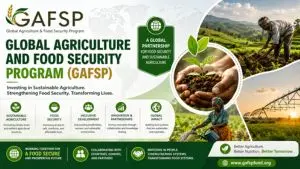
Food Security Program
GAFSP — Ending Hunger Through Agricultural Investment
The food we eat every day is supported by a vast and complex system. This system is now under severe pressure due to climate change, wars, natural disasters, and economic instability. Millions of people around the world still lack access to sufficient and nutritious food. To address this crisis, the Global Agriculture and Food Security Programme (GAFSP) was established—one of the world’s largest international financing programs for agricultural development and food security.
Global Challenge
Climate change, conflicts, natural disasters, and economic instability are placing increasing pressure on global food systems.
Food Security Need
Millions of people around the world still lack access to sufficient and nutritious food.
Global Response
The Global Agriculture and Food Security Programme (GAFSP) was created as one of the world’s largest international financing programmes supporting agriculture and food security.
What is GAFSP and Why Was It Needed?
Why GAFSP Was Created
Driven by this reality, GAFSP was established in 2010 at the initiative of G20.
Long-Term Food Security
Its main objective was not only to provide emergency food assistance but also to strengthen agricultural systems in the long term. So that countries could cope with future food crises.
Main Objectives of GAFSP
Increase food production and improve food security.
Increase the income of smallholder and marginal farmers.
Develop a sustainable and climate-resilient agricultural system.
Increase the participation of women and youth in agriculture.
Improve the nutritional status of children and mothers.
Encourage private investment in the agricultural sector.
How GAFSP Actually Works
GAFSP does not provide funds directly to farmers. Rather, it implements projects through governments, international development organisations, and private institutions. This programme mainly works in two parts.
Public Sector Window
In this window, developed countries such as the United States, the United Kingdom, and Canada contribute funds to the programme.
Low-income countries apply for this funding by submitting their own agricultural and food security plans.
Projects are implemented by organizations such as the World Bank, FAO, IFAD, and WFP.
This window mainly focuses on irrigation systems, market access roads, research, and farmer training.
Private Sector Window
This window is managed by the International Finance Corporation (IFC).
Here, loans, grants, and risk guarantees are provided to small and medium-sized agribusinesses, banks, and other organizations.
So that activities such as cold storage, food processing, and improving farmers’ access to credit can be expanded.
What Does GAFSP Do in Practice?
Providing improved seeds and training in modern farming methods so that crop yields increase even on small plots of land.
Developing irrigation systems and agricultural infrastructure.
Improving food storage, transportation, and market systems.
Increasing women’s participation in agriculture and promoting their financial inclusion.
Helping farmers cope with natural disasters and climate change.
Creating job opportunities by providing loans to small-scale businesses.
The Features That Set GAFSP Apart From Others
Country-Led
Not the donor country, the beneficiary country itself makes the development plans.
Quick Assistance
During times of crisis, GAFSP disburses funds much faster than regular development aid.
Focus on the Poorest
90% of the funds go to low-income and lower-middle-income countries, especially in Africa and Asia.
Links Agriculture, Nutrition & Climate
GAFSP doesn’t treat these as separate issues, instead it focuses on combined development.
The struggle to adapt to climate change
In today’s world, climate change is likely the biggest threat to agriculture. Irregular rainfall, prolonged droughts, sudden floods and extreme fluctuations in temperature – all of these have made farming increasingly uncertain. In light of this reality, climate-resilient agriculture is given central importance in GAFSP projects.
Long-Term Goal
The goal of these initiatives is not only to increase today’s yield, but also to sustain the agricultural system amid the uncertainties of the future.
Role of GAFSP in Nutrition Security
Increasing food production alone is not enough—the food also needs to be nutritious. That’s why many GAFSP projects specifically emphasize the production of nutritious foods like fruits, vegetables, pulses, and animal protein.
GAFSP’s Activities in Different Regions
GAFSP’s projects have been implemented in many countries across Africa, Asia, Latin America, and the Pacific region. Regional development institutions like the African Development Bank oversee these projects, while organizations like the FAO Investment Centre provide technical guidance.
Regional Development
Projects are supported by regional development institutions, including the African Development Bank.
Technical Support
Organizations such as the FAO Investment Centre provide technical guidance for project implementation.
Local Priorities
Although challenges differ in each region, projects are adapted to local agricultural needs and conditions.
Infrastructure Focus
Some projects focus on irrigation and water management, while others strengthen supply chains and storage facilities.
Results So Far
Latest Funding Round
In May 2026, GAFSP launched a new US$163 million grant program (9th call for proposals). The application deadline was 15 September 2026, and approval decision is expected in January 2027.
Challenges Still Remain
Related Post
- SEDFA Support Programmes (SEDA)
- Presidential Youth Employment Intervention (PYEI)
- NYDA Grant Programme
- Funza Lushaka Bursary
- REIPPPP Renewable Energy IPP
- Section 12B / 12BA Tax Allowances
- EEDSM Programme
- Blended Finance Scheme
- Agro Energy Fund (AEF)
- South African Medical Research Council (SAMRC)
- Comprehensive Agricultural Support Programme (CASP)
- Ilima/Letsema Programme
- National Research Foundation (NRF)
- National Student Financial Aid Scheme (NSFAS)
Frequently Asked Question (FAQs)
1Does GAFSP provide grants directly to farmers?
2When and why was GAFSP established?
3What does GAFSP’s Private Sector Window do?
4Where does GAFSP’s funding come from?
5Are there any special benefits for women farmers under GAFSP?
Disclaimer
This article has been prepared based on general and publicly available information regarding GAFSP. We are not affiliated with any wings of GAFSP.