
2026
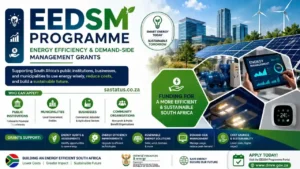
Energy Efficiency & Demand-Side Management Grants
The South African government has launched the Energy Efficiency and Demand Side Management (EEDSM) programme to make the country more energy-efficient by reducing electricity consumption.
Through this scheme, municipalities are provided with non-repayable grants so that they can replace older technologies with more energy-efficient ones in public facilities such as street lighting, offices, water pumps, and wastewater treatment plants.
EEDSM Programme
The primary objective of the South African government’s EEDSM programme is to make municipalities more energy-efficient. The results are now becoming visible.
Where are The Highest Energy Savings Areas
EEDSM funds are primarily spent on municipal infrastructure where the potential for energy savings is the greatest.
1. Traffic Signals
Replacing older lights with LEDs has resulted in electricity savings of up to 80%.
2. Street Lighting
Changing high-pressure sodium lights with LEDs has saved energy approximately 40% to 70%.
3. Office Buildings
Improving air conditioning, lighting, and insulation can reduce energy consumption by 20% to 30%.
4. Water Pumps
Using variable speed drives and energy-efficient pumping technologies has resulted in 15% to 25% energy savings.
5. Solar PV
Installing solar panels on rooftops or open land can reduce electricity consumption, with the level of savings depending on the location and site conditions.
Uses of The EEDSM Fund
EEDSM funds are used from the very beginning of the project to the final stage, including baseline assessments, business plan development, on-site implementation, final verification, and public awareness campaigns. Let’s understand where the funds are used.
Initial Energy Audit
At the very beginning of the project, an energy audit is conducted to determine how much electricity is being consumed across all municipal public infrastructure. Street lights, offices, and water pumps—all electricity bills and meters are checked.
Why- This is the reference point. Later, the amount of energy saved will be compared against it.
Project Proposal Preparation
After the audit, a detailed business plan is prepared in the DMRE-prescribed format.This plan must include the following three things:
1. Amount of energy to be saved – Energy Savings Target
2. How much the project will spend– Cost Estimate
3. Time required to recover the investment – Payback Period
If the DMRE approves the plan, only then will the funds be released.
Implementation
This is the main phase where the funds are used. All upgrading and replacement work is carried out using this fund, such as replacing old street lights with LED lights, upgrading office air-conditioning systems, installing variable speed drives in pumps, and installing rooftop solar panels.
Savings Verification
Upgrading and replacing equipment alone does not end the responsibility. A separate DMRE-accredited team will verify the actual amount of electricity saved. This is mandatory.
The DMRE will approve the project only if the verification team confirms that everything is in order.
Awareness and Outreach Activities
Replacing machines alone is not enough. Grant funds can also be used for training municipal staff, conducting community workshops, and running energy-saving awareness campaigns.
The Core Team Behind EEDSM
DMRE
The Authority Responsible for Funding and Decision-Making- Department of Mineral Resources and Energy
- manages the entire programme
- evaluates municipal proposals
- allocates funding to the approved projects.
- The key is in its hands.
Municipalities
The Groundwork Team- The fund is for their use
- They will first submit their project proposal to the DMRE
- Once the funding is allocated, they will carry out the required infrastructure upgrades and replacements.
SALGA
Municipalities’ Friend- SALGA represents the local government body constituted by all municipalities.
- If any municipality is new or faces difficulties, SALGA stands by them and provides support.
- If any municipality falls behind, SALGA helps it move forward.
GIZ (SAGEN)
Technical Expert- It is a Germany-based energy team.
- They provide technical advice to the DMRE and municipalities.
- Advice such as which LED is better and where solar should be installed to maximize energy savings is provided by GIZ.
- In simple terms, It is a team of proficient engineers.
MISA
Manpower Provider- It addresses the shortage of manpower.
- Many small municipalities do not have enough manpower.
- Engineers and officers are required for the project.
- MISA helps by providing these professionals.
- It also arranges training for staff.
Eligibility & Application Process
Who Can Apply?
All municipalities in South Africa qualify, whether metro, district, or local, doesn’t matter which one.
Municipalities that consume more power and have more potential for savings get preference.
The project has to be based on tested and efficient energy technologies that can pay back in a very short period of time.
It would be best if the municipalities that are part of the V-NAMA programme came forward for their projects.
The project must be included in the IDP of the municipality; it cannot be a stand-alone project.
The municipalities should fix concrete saving goals in terms of kWh and report to the DMRE monthly about how much progress is being made.
If some other agency is doing the implementation, there should be an implementation agreement.
What Municipalities Must Deliver
Extended Baseline
An extended baseline for all possible projects under the EEDSM programme in the municipality
Priority Projects
A short list of priority projects for the current financial year
Consumption Baseline
A detailed electricity consumption baseline for the projects that get shortlisted
Energy Audit Report
An energy audit report which combines both the extended and detailed consumption baselines
Business Plan
A Business Plan on the DMRE’s own template, including savings targets and cost projections
Monthly Progress Updates
Municipal Manager approved monthly progress updates
Quarterly Reports
Quarterly reports submitted to the DMRE in September, December, March, and June
Independent Verification
Independent verification (M&V) confirming the actual energy savings achieved
EEDSM Grant Application Process
Annual Call for Proposals
Usually in the month of October, the DMRE opens up applications for proposals from all municipalities. It consists of the kind of projects eligible for funding, the criteria and the documentation to be submitted. The municipalities have to submit their proposals by September 30 of the following fiscal year.
Energy Audit and preparation of project proposal
Before the municipality can apply, it must carry out an energy audit so that it gets an idea of the areas which have potential for power savings. This will then be followed by the selection of short listed key projects for implementation. After that, the project proposal has to be prepared in accordance with the format set out by the DMRE. This may require the involvement of external experts.
DMRE Evaluates Proposals and Allocates Funds
DMRE reviews all project proposals. Factors such as energy-saving potential, the cost-benefit ratio, and the investment payback period are considered during the evaluation. Selected municipalities receive grants, but they must first sign an agreement with DMRE. These grants are provided under the DORA Act.
Implementation of the Project and Procurement
After the grant application has been issued, the municipality goes ahead and purchases the energy efficient machinery like the traditional streetlights are changed to LED streetlights. These changes are carried out in accordance with the quality standards of DMRE. Energy saving reports need to be submitted to the DMRE on a monthly and quarterly basis, starting from July.
Verification and Completion of the Project
Once the municipalities are finished with their work, the evaluation is done by the independent evaluators to find out the actual reduction in the usage of electricity. On the basis of this report, DMRE evaluates if the project has achieved its goals.
Unspent Funds and Grant Redistribution
Only 76% of the allocated budget has been used from 2016 to 2021, while the R246.2 million remains unused.
Municipalities that do not provide progress reports by the end of December or do not comply with the programme terms will have their budgets cut off.
The money will be transferred to other municipalities which performed better in implementation of the programme.
Poor implementation is caused by lack of staffing, procurement problems and lack of energy officers.
EEDSM Matters to South Africa Future
Tips for Municipalities Applying for the Programme
Related post
- SEDFA Support Programmes (SEDA)
- Presidential Youth Employment Intervention (PYEI)
- NYDA Grant Programme
- Funza Lushaka Bursary
- Global Agriculture and Food Security Program
- REIPPPP Renewable Energy IPP
- Section 12B / 12BA Tax Allowances
- Blended Finance Scheme
- Agro Energy Fund (AEF)
- South African Medical Research Council (SAMRC)
- Comprehensive Agricultural Support Programme (CASP)
- Ilima/Letsema Programme
- National Research Foundation (NRF)
- National Student Financial Aid Scheme (NSFAS)
Frequently Asked Questions (FAQs)
1. Which municipalities can apply for EEDSM funding?
2. What kind of projects does EEDSM actually cover?
3. How much of the project cost does the government fund?
4. Is street lighting still eligible under this programme?
5. What if the municipality itself is unable to run the project?
Official Links & Resources
Municipal EEDSM Portal
Templates, examples, guides
DMRE Official Website
Department of Mineral Resources and Energy
IEA Policy Profile
International Energy Agency overview of EEDSM
DoRA Grant Frameworks
National Treasury – Conditional grant conditions
SALGA
SA Local Government Association – Municipal support
GIZ SAGEN Programme
SA-German Energy Programme – Technical support